 William BensonVIEW PROFILE →
When a Photo Goes Viral, the Village Locks Its Doors: Inside the Backlash Against Instagram Tourism
Somewhere between the algorithm rewarding "hidden gem" content and travelers chasing the exact same photo, a growing number of small, fragile destinations have quietly stopped being able to cope with the attention. In 2026, some of them have simply started closing the gate.
Somewhere between the algorithm rewarding "hidden gem" content and travelers chasing the exact same photo, a growing number of small, fragile destinations have quietly stopped being able to cope with the attention. In 2026, some of them have simply started closing the gate.
There's a particular kind of place that used to survive on word of mouth alone: a switchback trail known mostly to hikers who'd traded notes with each other for years, a pastel-colored lakeside town two trains and a ferry from the nearest airport, a temple street where the only crowd on a Tuesday morning was a handful of monks. None of these places were built to handle a spike. They were built for a trickle, a few hundred visitors a year who found out about them the slow way. Then someone posted a single photo with the location pin attached, the algorithm decided it liked the colors, and the trickle became a flood in a single season. That's the pattern repeating itself across the map in 2026, from an Austrian lake town that became an unlikely filming-location pilgrimage site, to a blue-washed hill town in Morocco, to a Norwegian fishing village whose single narrow road was never meant to carry tour buses. Roughly three in four travelers now say they turn to social media when deciding where to go next, and the destinations that photograph the most strikingly are the ones absorbing the fallout, narrow streets never engineered for crowds, water systems sized for a few thousand residents rather than a few million annual visitors, and local businesses that can't decide whether the sudden fame is a blessing or the beginning of the end. The algorithm doesn't know what a place can actually hold A viral photo travels with none of the context that made a place special in the first place. It doesn't come with a note about the size of the parking lot, the capacity of the footpath, or the fact that the "secret waterfall" is a forty-minute walk down a trail that erodes badly after heavy rain. It just comes with a pin. And because the same handful of platforms reward novelty over nuance, the fastest way for a quiet destination to go viral is often the exact thing that makes it the least prepared to handle what comes next.
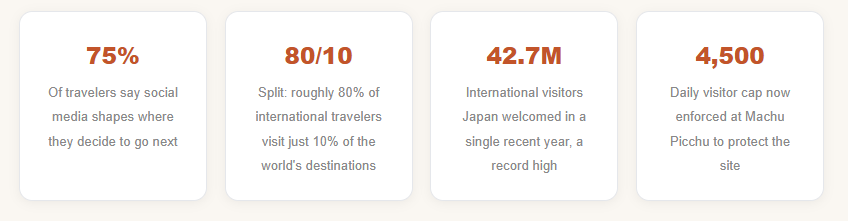
Nowhere illustrates this better than a small Austrian lake town that spent years as a quiet postcard destination before a single viral wave of interest, amplified by social sharing and a wildly popular piece of pop culture set that resembled it, sent visitor numbers soaring past what its population of a few hundred residents could reasonably absorb. Tour buses began arriving before sunrise. Locals eventually installed a wooden screen at the town's most photographed viewpoint, not to be difficult, but because the daily crush of visitors trying to recreate the same shot had made it genuinely unsafe to walk through at certain hours.
When the traffic problem is literal, not metaphorical
Overtourism gets discussed as an abstract cultural complaint, but on the ground it's frequently just a logistics failure. Streets in old towns and fishing villages were laid out centuries before anyone imagined a coach carrying forty people trying to turn around in them. A blue-painted hill town in northern Morocco, beloved for the particular shade of indigo washed over nearly every wall, now manages daily waves of visitors squeezing through alleyways barely wide enough for two people to pass, all chasing near-identical photographs of the same three or four corners. The town's charm was never designed to be a backdrop for a queue.
What "carrying capacity" actually means
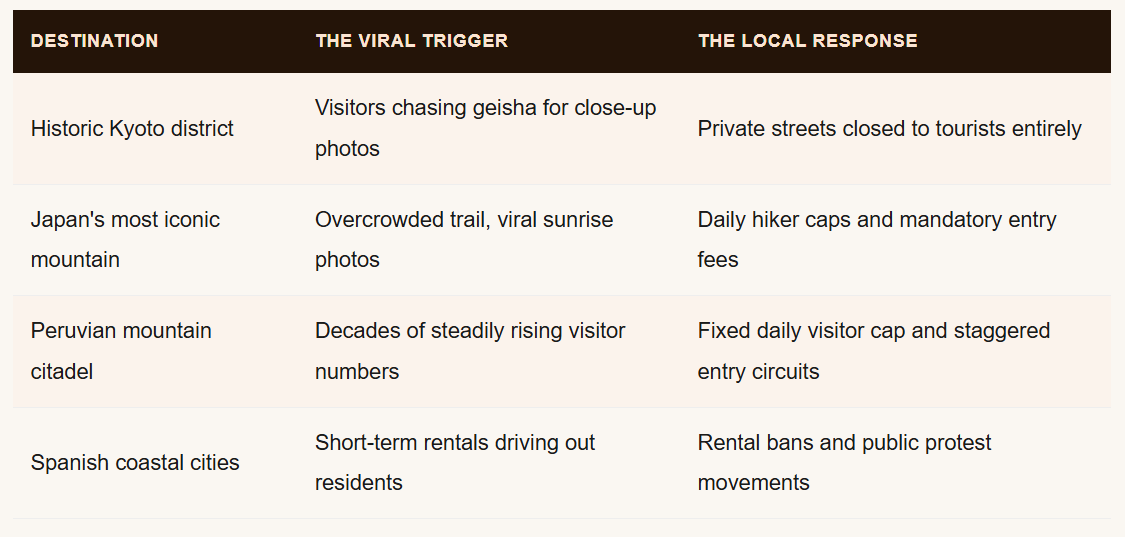
Tourism researchers use the term carrying capacity to describe the maximum number of visitors a site can absorb before the experience degrades for everyone, residents and travelers alike. A trail can only fit so many hikers before erosion sets in. A historic quarter can only fit so many rolling suitcases before the sound alone becomes the defining feature of living there. Japan's most iconic mountain now caps how many hikers can start a climb each day and charges an entry fee specifically to keep numbers within what the trail and its infrastructure can handle, a shift from open access to something closer to a reservation system.
Geotagging and viral travel content routinely turn quiet, undiscovered corners into "must-visit" spots overnight, often with no regard for how much traffic that location was ever built to hold.— A pattern documented across multiple 2026 tourism research reports
Photo: Unsplash — historic streets never designed for modern crowd volumes have become the physical bottleneck at the center of the overtourism debate.
Why some destinations have simply started saying no
What's changed most in 2026 isn't the volume of visitors, it's how directly destinations are now willing to push back. In Kyoto's Gion district, home to Japan's remaining geisha and apprentice geiko, authorities took the unusual step of banning tourists from entering certain private streets entirely, after repeated incidents of visitors chasing performers for photos. Dedicated tourism patrols now walk sections of Kyoto and Tokyo specifically to enforce basic etiquette. In parts of Spain, frustration has spilled into open protest, residents marching with water pistols aimed at tourists as a pointed, unmistakable message about who a neighborhood is supposed to belong to.
None of this is really about resenting tourists as people. It's a response to volume outpacing infrastructure, again and again, in places that never had a vote on becoming famous. A small Norwegian fishing village whose entire economy once depended on modest, respectful visits now regularly sees its single access road gridlocked by tour buses attempting to reach a viewpoint that looked irresistible in a thirty-second video, with nowhere for those buses to actually turn around.
The dispersal experiment: can attention be spread out instead of shut down?
Not every destination is choosing to close its doors. A parallel strategy, dispersal, is gaining traction among tourism boards who'd rather redirect the wave than fight it. Italy has actively promoted lesser-known regions and shoulder-season travel instead of letting every visitor funnel through the same three cities, a strategy credited with helping the country's tourism sector post record economic contributions without the same backlash seen elsewhere. Thailand has taken a similar approach, steering visitors toward secondary regions rather than concentrating everyone in its two most photographed cities.
Worth knowing before you plan a trip around a viral spot
If a destination went viral within the last year or two, its infrastructure very likely hasn't caught up yet. Checking for entry caps, permit requirements, or seasonal closures before booking isn't just considerate, it's increasingly the only way to actually get in. Some of the most photographed viewpoints in the world now require reservations made weeks in advance.
What travelers can actually do about it
The uncomfortable truth is that anyone reading an article like this one is, by definition, part of the audience that makes a hidden gem stop being hidden. That doesn't mean the instinct to travel somewhere quiet and beautiful is the problem. It means the old habit of geotagging the exact GPS coordinates of a fragile place, rather than just naming the region, has real consequences that used to be invisible and no longer are.
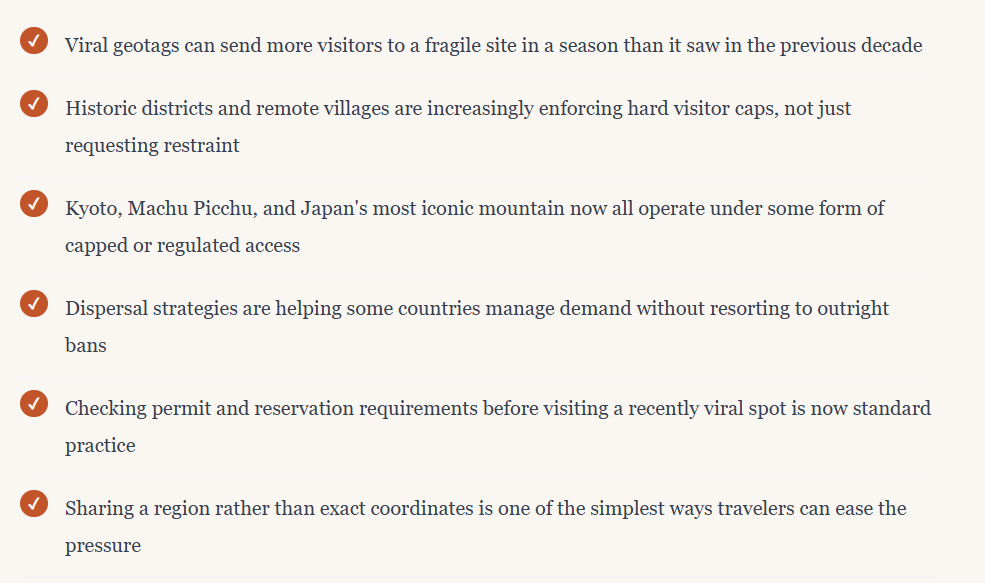
None of this points toward tourism disappearing, the industry remains one of the largest economic engines on the planet, and most destinations genuinely want visitors to keep coming. What's shifting is the tolerance for growth with no plan behind it. Places that spent years quietly absorbing whatever attention came their way are now, for the first time, setting the terms themselves.
The honest caveat is that this remains a patchwork response. Some regions have built real, thoughtful capacity management; plenty of others are still improvising fee structures and caps in real time as the crowds show up. But the direction is clear enough. A hidden gem that goes viral without a plan behind it doesn't stay a hidden gem, and doesn't always stay open, either.