 William BensonVIEW PROFILE →
Why $100,000 a Year Doesn't Feel Like "Making It" Anymore
A deep dive into inflation, lifestyle creep and regional cost-of-living spikes quietly eating the six-figure dream from the inside out.
A deep dive into inflation, lifestyle creep and regional cost-of-living spikes quietly eating the six-figure dream from the inside out.
There used to be a specific kind of relief that came with a six-figure job offer. You'd tell your parents. Maybe you'd cry a little. It meant you'd crossed some invisible line into financial adulthood, the kind where rent stops feeling scary and a grocery run doesn't require mental math. For a huge number of people earning exactly that salary in 2026, that relief never really arrives. The number on the offer letter still says $100,000. The feeling that's supposed to come with it just doesn't show up. This isn't a story about ingratitude or bad budgeting, even though that's usually the first accusation thrown at anyone who says it out loud. It's a story about arithmetic, and once you actually run the numbers, the gap between what $100,000 used to buy and what it buys now becomes impossible to ignore. What $100,000 Actually Turns Into After Taxes The gap starts before a single bill gets paid. For a single filer taking the standard deduction under 2026's federal brackets, that gross $100,000 salary works out to something closer to $75,000 after federal income tax and FICA contributions alone, before state tax even enters the picture in states that charge it. Split across twelve months, that's roughly $6,250 landing in a bank account, not the tidy $8,333 the gross number implies. From there, the fixed costs start stacking immediately. The median mortgage payment in the US reached roughly $2,070 a month in early 2026, driven by a combination of still-elevated home prices and mortgage rates hovering in the low-to-mid six percent range. Add employer-sponsored family health coverage, where the average worker's own contribution climbed to around $6,850 a year, and a meaningful chunk of that six-figure salary has already been spoken for before a single grocery bag comes home.
The Real Culprit Isn't Spending, It's Purchasing Power
It's tempting to blame the squeeze on overspending, oat milk lattes, streaming subscriptions, the usual internet punchlines. The bigger driver is far less satisfying to point at: inflation has quietly eroded what the same dollar amount is actually worth. Even with headline inflation sitting at a relatively modest rate, the compounding effect over several years is significant. A $100,000 salary today buys roughly what $87,000 bought back in 2020, and what closer to $71,000 bought in 2010.
Economists have a specific term for this gap: the difference between nominal wage growth, the raw number on your paycheck, and real wage growth, what that number can actually purchase once inflation is factored in. Wages have generally kept rising in nominal terms, but the pace at which real purchasing power grows has been considerably slower, which is exactly why a rising salary can coexist with a shrinking sense of financial breathing room.
"In 2026, $100K is what it costs to be comfortable, in the cities where you're most likely to earn it." — Daily Budget Life, personal finance analysis

Lifestyle Creep: The Quiet Tax No One Budgets For
There's a second force at work here that has nothing to do with tax brackets or inflation reports, and it's one that hits precisely the people earning good salaries the hardest. Financial researchers call it lifestyle creep, the gradual process by which comforts that once felt like luxuries quietly get reclassified as necessities as income rises. The nicer apartment. The car upgrade. The subscription boxes. None of it feels reckless in the moment, it feels proportionate, which is exactly what makes it so easy to miss.
What makes lifestyle creep particularly stubborn is the psychological trap layered on top of it. Watching friends buy homes or upgrade cars creates a kind of ambient financial peer pressure, even when those same friends might be quietly carrying credit card debt to fund the appearance of getting ahead. The comparison becomes the trap: if they can apparently afford it, shouldn't I be able to as well?
How to actually catch lifestyle creep in real time
Rather than tracking your salary size, track how many of your fixed monthly costs, rent payments, grocery carts, healthcare visits, that salary can actually cover before the money runs out. Watching that ratio over time reveals lifestyle creep far faster than watching your bank balance alone.
Even Half-Million-Dollar Earners Feel It
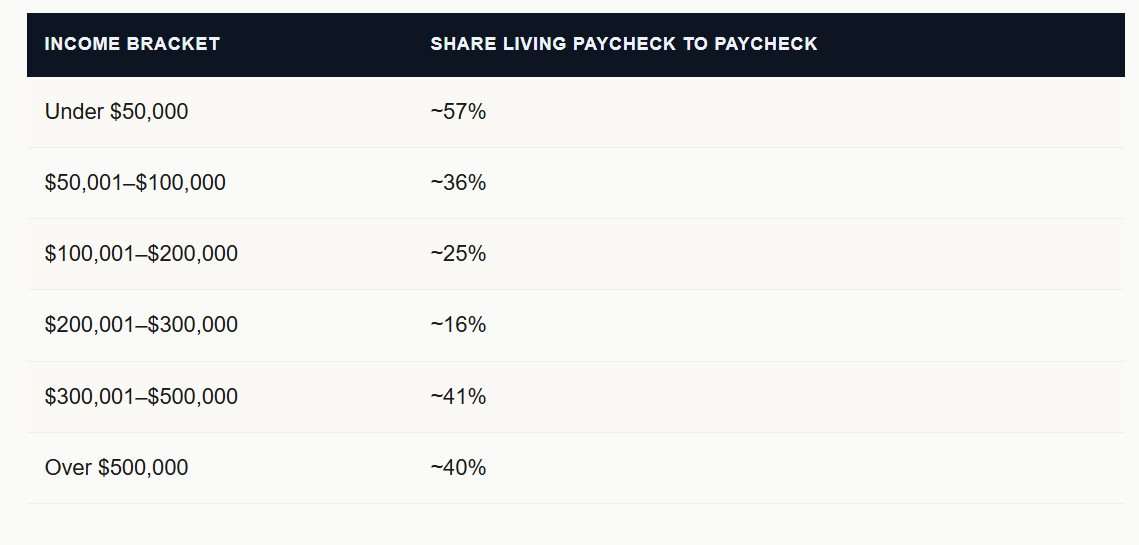
Perhaps the most counterintuitive part of this entire story is how far up the income ladder the squeeze actually extends. According to a widely cited Goldman Sachs report, roughly 41 percent of workers earning between $300,001 and $500,000 a year, and around 40 percent of those earning more than $500,000, say they're living paycheck to paycheck. That's a genuinely strange finding on its face: how does someone earning half a million dollars a year run out of money before the next paycheck arrives?
The answer traces straight back to lifestyle creep operating at a larger scale. Higher earners tend to expand their fixed costs in proportion to their income, larger homes, private schooling, more frequent travel, until the gap between income and outflow narrows regardless of how many zeroes sit on the salary. It's a reminder that the six-figure squeeze isn't really about the specific number $100,000, it's about a much broader mismatch between rising costs and the pace at which spending habits typically expand alongside income.
Location Is Doing More Work Than the Salary Itself
None of this plays out evenly across the country, and that's part of what makes the "six figures = rich" framing so misleading in the first place. A $100,000 salary in a smaller metro area with relatively affordable housing can genuinely still stretch into a comfortable life. That same salary in a major coastal city, where rent alone can eat a third or more of take-home pay before anything else gets paid, tells an entirely different story.
The people most likely to actually earn six figures also tend to cluster in exactly the cities where the cost of living has climbed the fastest, tech hubs, financial centers, major metro areas with the deepest job markets. That overlap is precisely why so many six-figure earners describe feeling squeezed: the salary and the cost of living rose together, largely canceling each other out.
Why "just move somewhere cheaper" isn't simple advice
The jobs that pay six figures are disproportionately concentrated in expensive metro areas for a reason, that's often where those industries and employers are based. Relocating to cut costs frequently means trading salary along with rent, which can leave someone in a similar financial position with a very different zip code.

The HENRY Problem: High Earner, Not Rich Yet
This pattern has become common enough that it earned its own acronym: HENRY, short for High Earner, Not Rich Yet. It describes people, often in their thirties, pulling in what looks on paper like an enviable salary while still feeling nowhere close to the financial security that number is supposed to represent. It's not that the income isn't real. It's that the gap between gross salary and genuine financial slack has narrowed dramatically compared to a generation ago.
What tends to separate HENRYs who eventually build real wealth from those who stay stuck in the cycle isn't the size of their paycheck, it's whether they build a deliberate system for where the extra money goes the moment it arrives. Left unmanaged, higher income tends to simply raise the ceiling on lifestyle creep rather than translating into savings or investment.
What actually protects against the squeeze
The research consistently points toward the same handful of levers mattering more than salary size alone: an intentional savings rate, smart housing decisions relative to income, and resisting the pull to scale lifestyle upward every time a raise lands. People who invest a meaningful share of each raise, rather than letting it quietly absorb into rent, dining out, and upgraded everything, tend to report feeling more financially secure even without dramatically larger paychecks.
So Is $100,000 Still a Good Salary?
By national standards, yes, unambiguously. Roughly one in five American workers earns six figures or more, which still places that income well above the national median. The disconnect isn't really about whether $100,000 is objectively a strong salary, it clearly still is. The disconnect is between that number and the specific cultural expectation attached to it: the idea, largely inherited from decades past, that six figures automatically buys a particular kind of ease and security.
That expectation was built in a very different cost environment. In 2026, $100,000 still represents real financial strength, but it functions more like a solid foundation for careful planning than a finish line that guarantees comfort on its own. The number hasn't lost its value entirely, it's simply being asked to do a lot more work than it used to.