 William BensonVIEW PROFILE →
Why 2026 Is the Year the Password Actually Started to Disappear
Apple, Google, and Microsoft all bet on the same replacement for the password. Now the numbers are in, and they explain why criminals who built entire industries around stealing your login are suddenly running out of road.
Apple, Google, and Microsoft all bet on the same replacement for the password. Now the numbers are in, and they explain why criminals who built entire industries around stealing your login are suddenly running out of road.
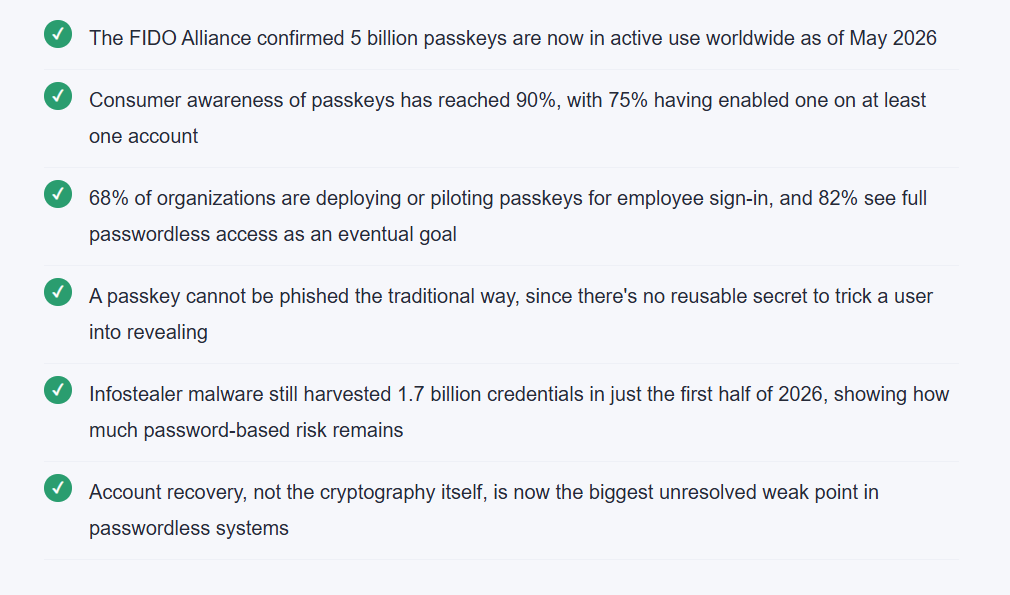
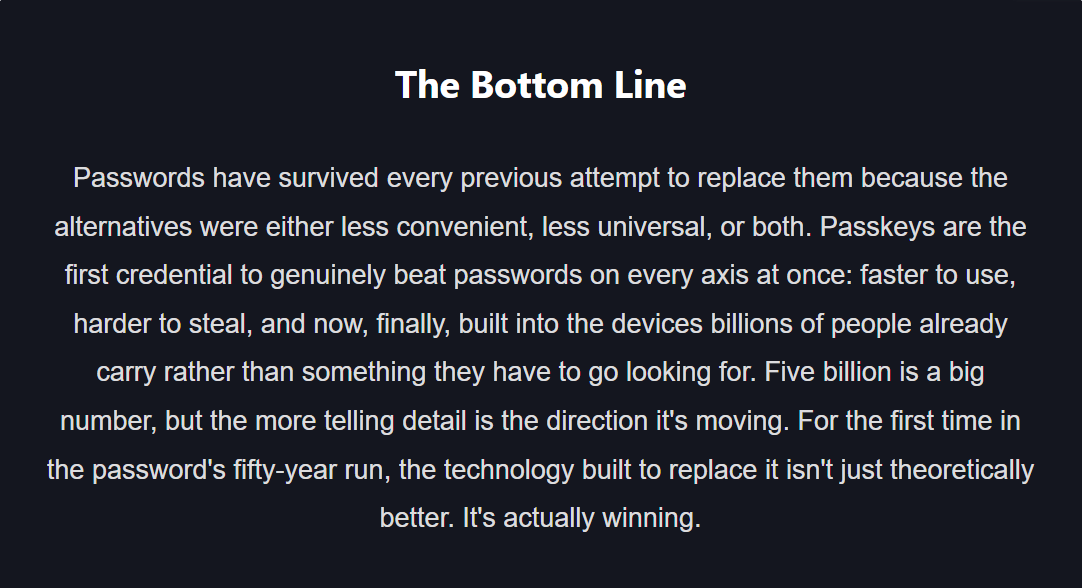
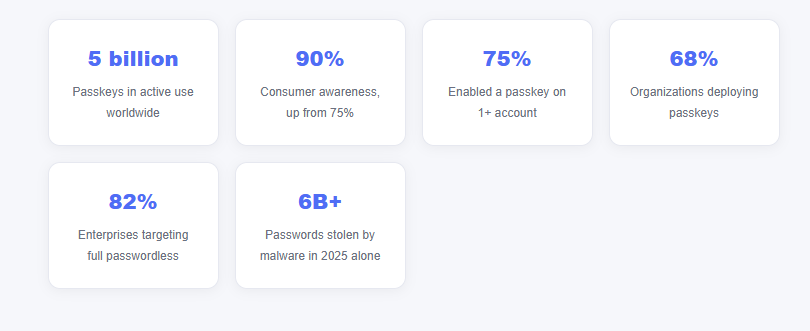
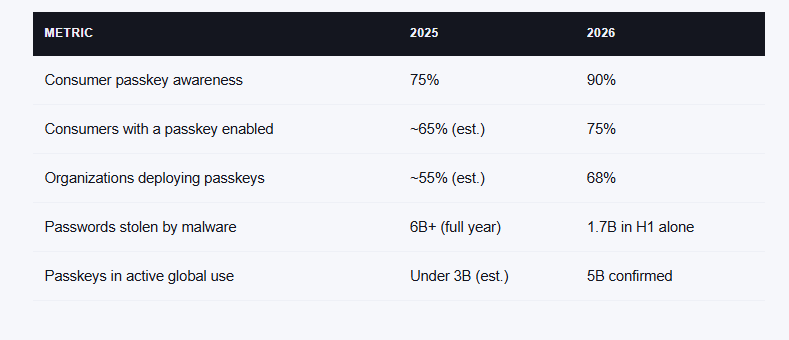
Every year for roughly the last decade, some corner of the tech industry has declared the password dead, and every year, billions of people kept typing the same eight-to-twelve characters into login boxes anyway. What makes 2026 genuinely different isn't a prediction or a product launch. It's a number: five billion passkeys now sit in active use across the world's biggest platforms, and the survey data behind that figure suggests the shift has stopped being a niche security habit and started becoming the default way ordinary people log in. The Milestone, and Why the Timing Isn't a Coincidence The five-billion figure came from the FIDO Alliance, the industry body that has spent years shepherding the technical standard behind passkeys, announced on World Passkey Day in May 2026. It wasn't a marketing estimate pulled from thin air. The number is backed by the organization's State of Passkeys 2026 report, built from a consumer survey of 11,000 people and a workforce survey of 1,400 enterprise decision-makers, spanning ten countries including the United States, United Kingdom, Germany, Japan, and India. The headline adoption numbers are striking on their own. Awareness of passkeys has climbed to 90% among consumers, up sharply from 75% just a year earlier. Roughly three in four people have enabled a passkey on at least one account, and just under half say they use one regularly whenever a service offers the option. On the enterprise side, 68% of organizations report they've deployed, are piloting, or are actively rolling out passkeys for employee sign-in, and 82% name a fully passwordless workforce as an explicit long-term goal, with more than a quarter saying they've already gotten there. What separates 2026 from every previous year passwordless authentication was "about to happen" is alignment. Apple, Google, and Microsoft are no longer competing on how you log in, they're all building toward the same open standard, which turns adoption from a choice users have to seek out into the default path of least resistance. What a Passkey Actually Is, in Plain Terms Strip away the marketing language and a passkey is a pair of cryptographic keys generated the moment you set one up. One half stays locked to your device, unlockable only by your fingerprint, your face, or your device passcode. The other half lives on the website or app's server. When you sign in, your device and the server perform a cryptographic handshake that proves you hold the private key, without that key, or any secret resembling a traditional password, ever crossing the internet. That single design choice quietly eliminates the most valuable target in cybercrime: a reusable secret sitting in a database somewhere, waiting to be stolen. There's no password for a breached company to leak. There's no shared string for a fake login page to trick out of you. A passkey simply cannot be phished the way a password can, because there's nothing transferable to hand over in the first place, even if you're staring at a perfect replica of your bank's login page.
The Criminal Economy Passkeys Are Built to Shut Down
To understand why this shift matters so much right now, it helps to look at exactly what's been happening on the other side of the equation. Security researchers at Specops tracked more than six billion passwords stolen by malware in 2025, and infostealer activity has only accelerated since. Flashpoint's midyear 2026 threat intelligence report found infostealer malware harvested 1.7 billion credentials from 7.4 million infected devices in just the first six months of the year. In June 2026, researchers at Cybernews discovered a single exposed database containing more than 24 billion stolen credential records, over 8.3 terabytes of usernames, plaintext passwords, and login URLs, sitting on the open internet with no protection of its own.
Why stolen passwords are worse than they sound
Modern infostealer malware doesn't just grab your password, it often steals active session cookies too, which means an attacker can sometimes impersonate an already-logged-in session and bypass multi-factor authentication entirely. Microsoft has reported that roughly 97% of identity attacks it tracks are still password-based. Passkeys don't patch around this problem. They remove the reusable secret the entire attack chain depends on.
From Enthusiast Feature to Everyday Default
Passkeys existed in some form for years before 2026 without gaining mainstream traction, largely because using one required deliberately opting in, hunting through account security settings most people never touch. What changed is that the plumbing moved from optional to built-in. Apple's iCloud Keychain, Google's Password Manager, and Microsoft's identity platform now support passkeys natively across the vast majority of consumer and workforce devices already in people's pockets and on their desks. Increasingly, when a service offers a passkey, it's presented as the obvious first choice during setup rather than a buried option for security enthusiasts to discover.
That shift from opt-in to default is, historically, the single biggest predictor of whether a security technology actually spreads. Two-factor authentication existed for years as an available option before it became something services actively pushed users toward, and it only reached mass adoption once platforms started nudging people rather than waiting for them to seek it out. Passkeys appear to be following the same curve, just compressed into a far shorter window.

Businesses have their own reason to push harder
For companies, the case for going passwordless isn't only about security, it's increasingly about lost revenue. Industry surveys have found that roughly 47% of consumers abandon an online purchase entirely when the login process becomes frustrating, a friction cost that passkeys largely eliminate by replacing a typed password and a second-factor code with a single fingerprint tap. Combined with the enterprise push toward zero-trust security architectures, where passwordless authentication is increasingly treated as a foundational requirement rather than a nice-to-have, businesses now have both a security argument and a conversion-rate argument pointing in the same direction.
Why the Password Isn't Quite Dead Yet
It would be a mistake to declare this transition finished. Passwords remain deeply embedded in legacy systems, older enterprise software, and edge-case account types that haven't been rebuilt to support passkeys, and that long tail of holdouts will likely take years, not months, to shrink to nothing. The password is retreating, not vanishing.
There's also a genuine unsolved problem sitting underneath the whole system: account recovery. If your passkey lives on a device you lose, break, or have stolen, getting back into your account without falling back on a weaker verification method becomes the hardest part of the entire design. A sloppy recovery flow can quietly undermine even the strongest possible login credential, since attackers who can't phish your passkey directly will simply target the recovery process instead. Getting that piece right, arguably more than the cryptography itself, is what will determine how safe this transition actually turns out to be.