 William BensonVIEW PROFILE →
Why Every Village in India Might Soon Have Better Internet Than Your City Apartment Did Five Years Ago
Four years, three regulators, and two billionaire rivals turned partners , here's how satellite internet is finally coming to India.
Four years, three regulators, and two billionaire rivals turned partners — here's how satellite internet is finally coming to India.
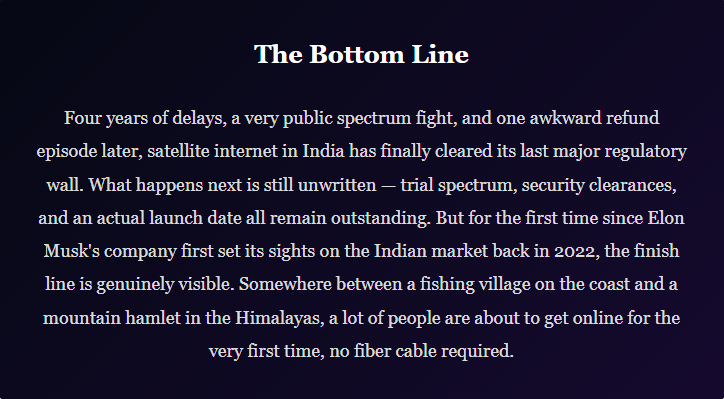
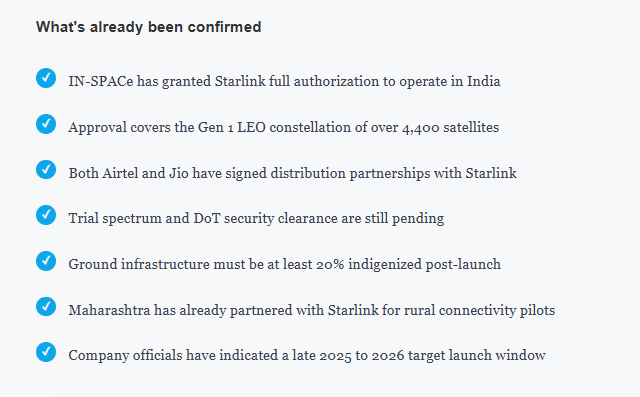
Somewhere in a mountain village in Himachal Pradesh, or a fishing hamlet on the Odisha coast, someone is about to get online for the first time — not through a cell tower, not through a fiber cable dug across a hillside, but through a small white dish pointed at the sky. After close to four years of delays, licensing battles, and one very public rivalry between two of India's biggest telecom players, Starlink has finally cleared the last regulatory hurdle standing between it and the world's second-largest internet market. The Approval That Took Four Years to Arrive India's space regulator, IN-SPACe, granted Starlink its final authorization to operate low-Earth orbit satellite communication services in the country, making it the third satellite internet operator to clear every required regulatory hurdle, following Eutelsat OneWeb and the Jio-SES joint venture. The authorization specifically covers Starlink's Gen 1 constellation, a network of more than 4,400 satellites orbiting between 540 and 570 kilometers above Earth, capable of delivering roughly 600 gigabits per second of total throughput across the country. That number sounds abstract until you consider what it actually solves. A meaningful share of India's population, especially across its more remote and mountainous regions, still lacks reliable access to conventional broadband, simply because laying fiber or erecting cell towers across difficult terrain is slow and expensive. Satellite internet sidesteps that problem entirely — a dish and a clear view of the sky is functionally all that's required, regardless of how far the nearest fiber line happens to be.

From Rivals to Reluctant Partners: How Airtel and Jio Both Ended Up in Business With Musk
The path to this point has been anything but straightforward, and much of the drama centered on India's two dominant telecom operators, who spent years publicly disagreeing about how satellite spectrum should even be allocated in the first place. Reliance Jio, led by Mukesh Ambani, pushed for spectrum to be auctioned competitively, arguing that a level playing field required satellite operators to bid for access the same way terrestrial telecom players do. Bharti Airtel and international operators like Starlink favored administrative allocation instead, a system where spectrum gets assigned directly by regulators rather than sold to the highest bidder.
That fight became one of the most closely watched telecom policy battles in the country, largely because the outcome would shape how easily any international satellite operator could enter the Indian market at all. The government ultimately sided with administrative allocation in October 2024, a decision widely read as a win for Starlink and its international peers.
What happened next surprised almost everyone. Within days of each other in March 2025, both Jio and Airtel, despite years of public disagreement, announced separate distribution partnerships with Starlink. Airtel's chairman Sunil Mittal had previously been vocal about his skepticism toward the company's India ambitions, which made the reversal all the more notable. Under both arrangements, the telecom giants would distribute Starlink equipment and services through their existing retail and distribution networks, once SpaceX cleared the remaining regulatory approvals — turning two fierce competitors into parallel partners of the same foreign satellite provider.
Despite years of public rivalry over how satellite spectrum should be allocated, both Jio and Airtel signed on as Starlink distributors within days of each other — a reversal that surprised much of the industry.
What Still Needs to Happen Before You Can Actually Order One
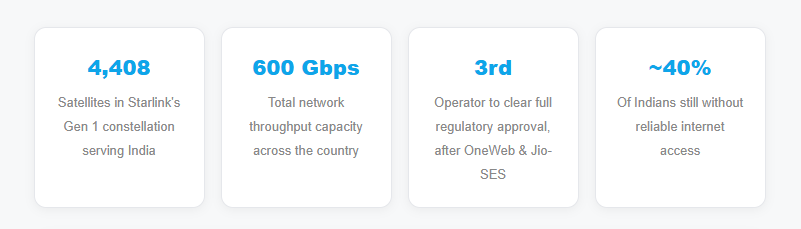
Clearing IN-SPACe's authorization is a major milestone, but it isn't the finish line. Starlink still needs to secure trial spectrum and satisfy a set of national security compliance conditions set by India's Department of Telecommunications before any commercial service can actually go live. Those aren't minor formalities. Regulators have required satellite operators to indigenize at least 20 percent of their ground infrastructure within a set timeframe after launch, obtain separate security clearances for every individual satellite gateway and hub site they operate in the country, and build in specific monitoring and lawful interception capabilities that Indian law requires of telecom infrastructure.
For context on how long this final stretch can take, Eutelsat OneWeb and the Jio-SES joint venture both secured their own trial spectrum back in 2024 and have since been granted six-month extensions while they continue working through final security clearances. That timeline gives a realistic sense of what Starlink likely faces next: not another multi-year wait, but a genuine final stretch that's still measured in months rather than weeks.
Why This Matters More in India Than Almost Anywhere Else
India isn't just a large market for satellite internet — it's arguably one of the markets where the technology solves the most acute real-world problem. With well over a billion people and vast stretches of mountainous, forested, or otherwise hard-to-wire terrain, the country has always faced a genuine last-mile connectivity challenge that traditional infrastructure struggles to solve economically. Laying fiber to a village of a few hundred households tucked into a Himalayan valley rarely makes commercial sense for a telecom operator; beaming a signal down from orbit to the same village does.
That's not a hypothetical benefit. India's telecom minister has pointed to satellite connectivity as central to closing the country's remaining digital divide, framing it as essential for reaching remote and rural regions that terrestrial infrastructure has struggled to serve even after more than a decade of rapid digital expansion. The country's mobile telephony sector has grown dramatically over the past decade, but that growth has been noticeably uneven, concentrated far more heavily in cities and large towns than in the country's most isolated regions — precisely the gap satellite internet is best positioned to close.

A Bumpy History That Explains Why This Took So Long
It's worth remembering that Starlink's road into India hasn't been a smooth, steady march toward launch. Back in 2022, the company found itself in trouble with Indian authorities for effectively beginning to take service pre-orders before it held any operating license at all, and it was ultimately forced to refund customers who had already paid for equipment. That episode set an early tone of caution around the company's entry into the market, and it partly explains why regulators have moved as deliberately as they have since.
Security and pricing concerns, along with lobbying from established domestic telecom players wary of a well-funded international competitor, further slowed the process for years. It wasn't until mid-2025 that Starlink secured its GMPCS license, a foundational step toward commercial operation, and the IN-SPACe authorization that finally arrived built on top of that. Set against that backdrop, the current approval represents the clearing of what's genuinely the most difficult and most contested regulatory obstacle Starlink has faced anywhere it has expanded globally.
A Few Straightforward Questions
When will Starlink actually be available to order in India? No confirmed public launch date exists yet, since trial spectrum and security clearances are still pending. Industry watchers have generally pointed toward a late 2025 to 2026 window, though the exact timing depends on how quickly the remaining regulatory steps are completed.
Will I be able to buy Starlink directly, or only through Airtel or Jio? Based on the announced partnerships, both telecom giants are expected to serve as distribution channels, selling Starlink equipment and service plans through their existing retail networks, rather than customers necessarily needing to order directly from SpaceX.
Is satellite internet only useful for rural areas? Rural and remote connectivity is the most obvious use case, but satellite internet can also serve as a backup connection for businesses, support disaster recovery scenarios where terrestrial infrastructure is damaged, and provide connectivity for mobile or temporary operations that can't easily rely on fixed infrastructure.
How does Starlink compare to Jio's own satellite service? Jio has been developing its own competing satellite broadband offering, JioSpaceFiber, through a joint venture with SES, and has already tested it in several districts. That means Jio is positioned as both a Starlink distribution partner and, through a separate venture, a potential future competitor in the same space — an unusual dual role that reflects how contested and strategically important this market has become.
Worth keeping in mind
Regulatory approvals, launch timelines, and partnership terms in India's satellite telecom sector have shifted repeatedly over the past several years and could continue to evolve. Treat specific dates and figures here as reflecting the most recent public statements available, and check official announcements from IN-SPACe, the Department of Telecommunications, or the telecom operators themselves for the latest updates before making any purchasing decisions.