 William BensonVIEW PROFILE →
Why Southwestern Ontario Has Become Canada's Busiest Cocaine Interdiction Corridor
Inside the seven border crossings where CBSA officers are seizing record volumes of cocaine, and what one massive cross-border bust revealed about the networks moving it.
Inside the seven border crossings where CBSA officers are seizing record volumes of cocaine, and what one massive cross-border bust revealed about the networks moving it.
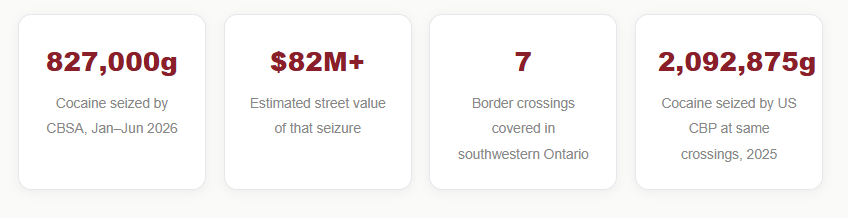
Every day, tens of thousands of commercial trucks rumble across the handful of bridges and tunnels linking southwestern Ontario to Michigan, carrying auto parts, produce, machinery, and nearly everything else that keeps two national economies running on schedule. Somewhere in that relentless flow of cargo, hidden inside legitimate-looking shipments, a different kind of freight has been moving too, and in 2026, Canada Border Services Agency officers have been catching more of it than almost anyone expected. The numbers, when you actually lay them out, are startling. And they raise an uncomfortable question that border officials themselves have had to answer publicly: if seizures keep climbing this fast, is that proof the system is working, or proof of just how much is still getting through? The Numbers Behind a Record Six Months Between January and the end of June 2026, CBSA officers seized more than 827,000 grams of cocaine, carrying a street value north of 82 million dollars, across seven crossings in southwestern Ontario: the Ambassador Bridge, the Detroit-Windsor Tunnel, the Blue Water Bridge, the Peace Bridge, the Queenston Bridge, the Rainbow Bridge, and the crossing at Walpole Island. That's a six-month total, meaning the pace, if it holds, points toward a full year that could rival or exceed anything the corridor has recorded before. Cocaine wasn't just the headline seizure, it was the single most intercepted substance along this stretch of border on both sides of the line. According to figures from U.S. Customs and Border Protection covering the same crossings, American officers seized 927,142 grams of cocaine in 2024 and a striking 2,092,875 grams in 2025, a nearly 126 percent jump in a single year. Whichever direction you look at the border from, cocaine has become the substance both agencies are catching more of than anything else.
Why This Particular Stretch of Border
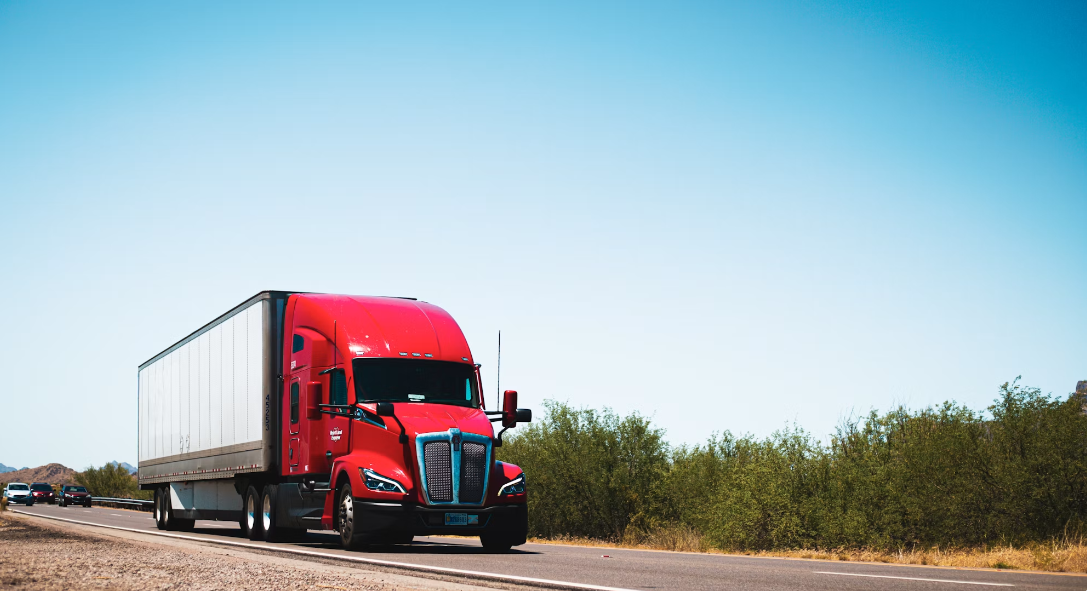
Southwestern Ontario's border crossings aren't just busy, they're some of the busiest in North America, period. The Ambassador Bridge alone carries a substantial share of all commercial trade between Canada and the United States on any given day, a sheer volume of legitimate traffic that traffickers have long understood works in their favor. Every truck an officer has to wave through without a full search is one more opportunity for something to slip past.
Justin Morgan, chief of operations with the CBSA at the Ambassador Bridge, has been direct about where the pressure is actually coming from. The bulk of the narcotics problem at this corridor involves substances entering Canada from the United States, not the other direction, flipping the usual assumption many people carry about which way illegal drugs typically flow across this particular border.
"The bulk of our business is the narcotics that are coming from the United States." — Justin Morgan, Chief of Operations, CBSA, Ambassador Bridge
A Perspective From the Other Side of the River
Interestingly, US officials monitoring the same crossings from the Michigan side describe a somewhat different picture of what's actually flowing which direction. Lavarah Miller, a Customs and Border Protection watch commander, has noted that a considerable share of what gets seized at the Detroit crossings is material heading toward Canada from the United States, rather than material coming from Canada into the US. Miller put it plainly: inbound traffic isn't really where the bulk of the concern sits, most of what American officers intercept is headed outbound, toward the Canadian side.
That perspective helps explain why cocaine numbers on both sides of this specific corridor have been climbing in tandem. It isn't one country simply exporting a problem to the other, it's a two-way trafficking corridor where enforcement on either side is catching pieces of the same underlying supply chain, just from different vantage points along the river.
The 1.7-Tonne Bust That Exposed the Network Behind It
If the seizure statistics tell the story in numbers, one specific case from earlier this summer tells it in human terms. In July 2026, an 18-month investigation known as Project Bay culminated in the seizure of nearly 1.7 tonnes of illegal drugs, primarily cocaine and methamphetamine, with an estimated street value of roughly 139 million dollars. Police also recovered 17 firearms during the operation, including a large anti-tank rifle, a detail that underscored just how far removed this kind of trafficking is from small-time street dealing.
The investigation began in January 2025 when the Windsor Police Service opened a drug-trafficking case that eventually drew in the CBSA, the Ontario Provincial Police, Toronto Police, Peel Regional Police, and support from the US Department of Homeland Security and the Drug Enforcement Administration. What started as a local investigation in a border city expanded, almost by necessity, into one of the largest cross-border trafficking cases the province has seen, spanning from street-level couriers all the way up to the brokers coordinating the operation internationally.
Why cases like this rarely stay local
Drug trafficking networks operating through a major border corridor almost never confine themselves to a single city. Investigators pursuing what looks like a local case frequently discover it connects to a much larger network spanning multiple police jurisdictions and, often, both sides of an international border, which is exactly what happened as Project Bay expanded.
Photo: Max Fleischmann / Unsplash — the 1.7-tonne Project Bay seizure involved a multi-agency response spanning municipal police, provincial police, CBSA, and US federal partners.
Windsor Police Chief on the Bigger Picture
Windsor police Chief Jason Crowley, who helped unveil the results of Project Bay at a news conference in the city, framed the stakes in terms that went well beyond the dollar value of what was recovered. He described the drugs seized as material that would not end up harming the community's most vulnerable residents, and pointed to the recovered firearms as weapons that would not go on to sow further chaos locally.
Crowley also situated the case within Windsor's particular geography. As a border city, he noted, the police force isn't simply combatting local crime, it's combatting a form of criminal activity that inherently moves across an international boundary, which requires exactly the kind of cross-agency, cross-border cooperation that made Project Bay possible in the first place.
The uncomfortable question officials had to answer
Ontario Provincial Police Detective Superintendent Andy Bradford directly addressed a question the 1.7-tonne seizure inevitably raised: does a bust this large mean border security actually failed somewhere along the line? His answer framed the seizure differently, as evidence of successful, sustained collaboration between Canadian and American law enforcement, and as proof of the tight, persistent link between drug trafficking networks and the risk of associated violence.
What Marijuana Numbers Reveal by Comparison
One detail that puts the cocaine figures in useful context: cocaine isn't the only substance moving through this corridor, but it's clearly the one drawing the most enforcement attention relative to its volume. Over roughly the same recent period tracked by CBP, marijuana seizures at these crossings actually outpaced cocaine seizures by weight, with 1,797,133 grams of marijuana intercepted compared with 242,218 grams of cocaine in that specific window.
That comparison matters because it highlights something about how these substances are treated differently by enforcement priorities and legal frameworks on each side of the border, despite marijuana's legal status in Canada. Cocaine's high value relative to its weight, along with the far more serious criminal penalties attached to trafficking it, keeps it as the primary focus for interdiction resources even when it isn't necessarily the highest-volume substance crossing by weight.
What changes with the Gordie Howe Bridge
Adding another layer to this evolving picture, the new Gordie Howe International Bridge, a major infrastructure project connecting Windsor and Detroit, has opened as an additional crossing point. The CBSA has indicated it will closely monitor how traffic patterns shift as a result, and plans to apply newer detection technology to the corridor as trade volume adjusts across the expanded network of crossings.
Where This Leaves the Fight Going Forward
Taken together, the data paints a picture of an enforcement effort that's intercepting more drugs than ever before, operating along a corridor that carries an enormous volume of legitimate trade every single day. Whether the rising seizure numbers represent traffickers getting bolder, enforcement getting sharper, or simply more product moving through North America's drug supply chains overall is a question without a single clean answer.
What does seem clear is that southwestern Ontario's border crossings have become a genuine focal point in the broader Canada-US fight against cocaine trafficking, one where cooperation between agencies on both sides of the river has become less of a formality and more of an operational necessity. As the Gordie Howe Bridge adds new capacity and new complexity to the corridor, that cooperation is likely to matter even more in the years ahead.