 William BensonVIEW PROFILE →
Why You're Always Tired (Even When You Sleep 8 Hours): The 7 Types of Rest You're Missing
Physical sleep is only one-seventh of the equation. Here's what the other six actually look like.
Physical sleep is only one-seventh of the equation. Here's what the other six actually look like.
There's a specific kind of exhaustion that doesn't make sense on paper. You went to bed on time. You got your eight hours, maybe even nine. You didn't stay up scrolling, didn't have caffeine after noon, did everything the sleep hygiene articles tell you to do. And yet by early afternoon, you're staring at your screen with the particular hollow, foggy heaviness that no amount of "good sleep" seems to touch. If that sounds familiar, the problem probably isn't your sleep at all. It's that sleep was never the whole assignment. For years, doctors and researchers who study burnout have been quietly making a distinction that most of us never learned: sleep and rest are not the same thing. Sleep is one specific, biological process that restores your body. Rest is a much bigger category, one that covers at least six other dimensions of depletion that eight hours of unconsciousness does absolutely nothing to fix. You can be fully sleep-satisfied and still be running a serious rest deficit, and that gap is exactly where most modern exhaustion actually lives. Why "just sleep more" stopped working for you The framework behind this idea comes largely from the work of physicians and researchers studying burnout in high-functioning professionals, people who, on paper, were doing everything right: exercising, eating reasonably, sleeping a full night, and still ending every day feeling like they'd been wrung out. What kept showing up in that research wasn't a sleep problem. It was a pattern of depletion happening across several separate systems at once, systems that sleep simply isn't designed to address. Physical rest is what most of us picture when we hear the word "rest," and it genuinely matters, but it's only the most visible slice of a much larger picture. Mental fatigue, sensory overload, emotional suppression, social depletion, a starved need for creativity, and a quieter, often-ignored spiritual disconnection can all sit underneath a full night's sleep completely untouched, accumulating in the background while your body technically gets all the recovery time it needs.
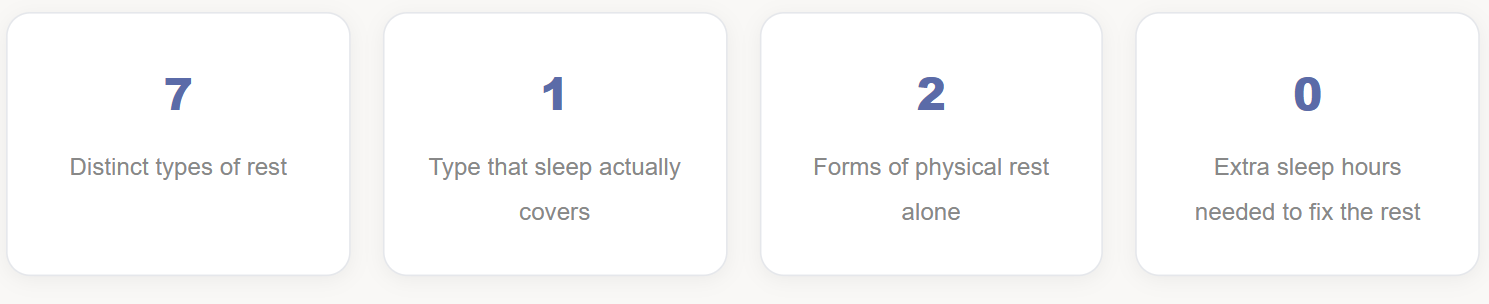
Fatigue isn't always a sleep problem. Sometimes it's a signal that a specific, unnamed part of you has been running on empty for a long time, quietly, underneath a schedule that looks perfectly healthy from the outside.
The seven types of rest, and how to spot which ones you're skipping
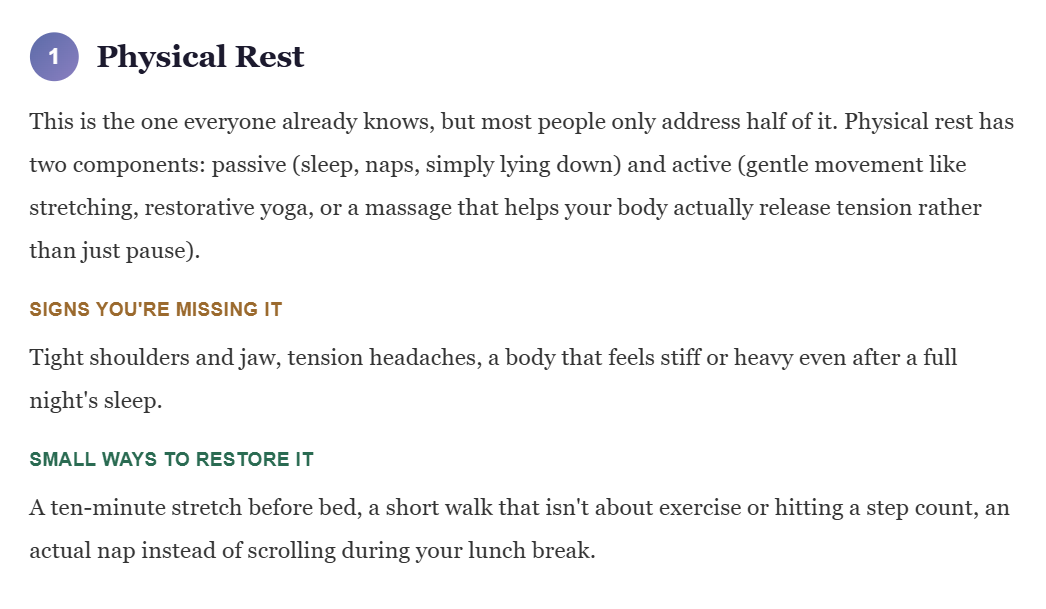
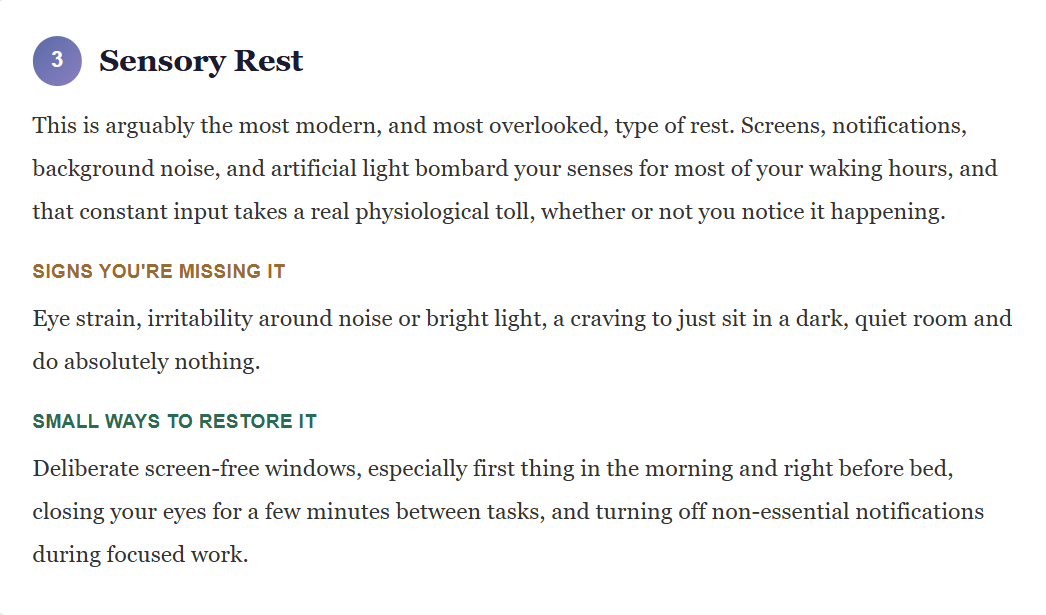
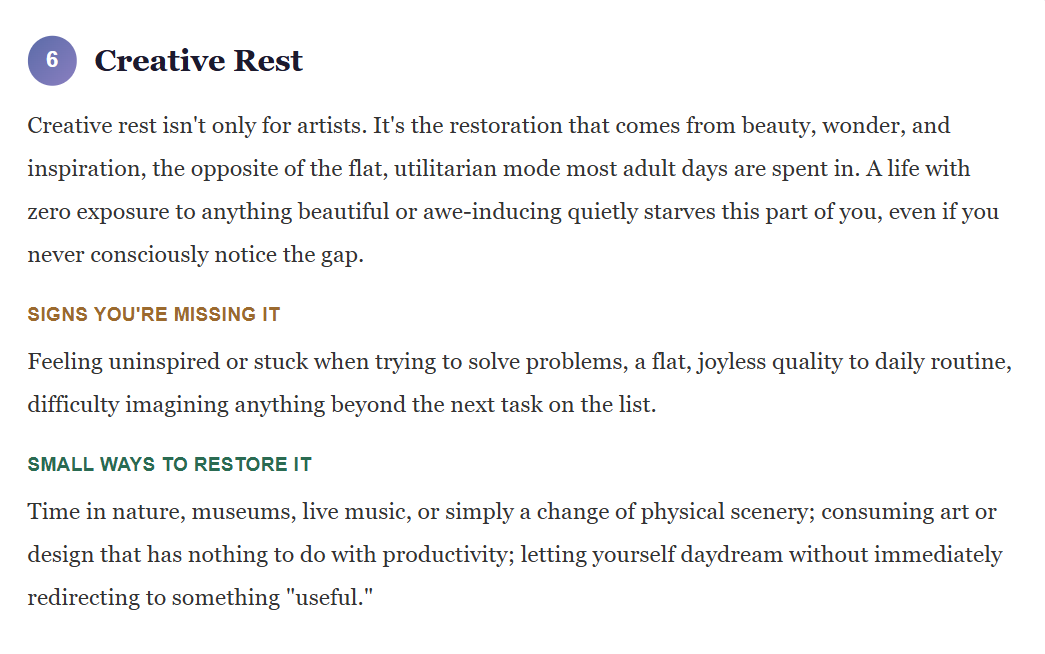
This framework, popularized by internal medicine physician Dr. Saundra Dalton-Smith after her own experience with burnout, breaks rest into seven categories: physical, mental, sensory, emotional, social, creative, and spiritual. They overlap in places, and restoring one often nudges another back into balance too, but each has its own distinct warning signs, and each needs its own distinct kind of attention rather than simply "more sleep" thrown at all of them at once.

Why these seven types tend to overlap, and why that's actually good news
One of the more encouraging parts of this framework is that the seven types of rest aren't seven separate chores competing for your limited free time. They overlap constantly. A walk outside can simultaneously deliver physical rest, sensory rest, and creative rest in a single twenty-minute window. An honest conversation with a close friend can cover both emotional and social rest at once. You don't need to schedule seven distinct recovery activities into an already packed week; you need to notice which categories are running lowest, and choose activities that happen to touch more than one at a time.
A quick way to check yourself
Ask which of these statements feels most true right now: "My body feels tense" (physical), "My brain won't slow down" (mental), "I need silence and darkness" (sensory), "I'm tired of managing everyone's feelings" (emotional), "I don't want to see anyone" or "I'm lonely" (social), "Nothing feels inspiring anymore" (creative), or "None of this feels like it means anything" (spiritual). Whichever one lands hardest is usually the type of rest you're most overdue for.
Why this matters more than it might seem
It's tempting to file this under "nice self-care idea" and move on, but the practical stakes are higher than that framing suggests. Chronic, unaddressed rest deficits, across any of these seven categories, are widely linked by burnout researchers to declining focus, worsening mood, weakened immune function, and a slow erosion of the exact motivation and creativity that make work and relationships feel worthwhile in the first place. Sleep alone can't reverse that erosion if the underlying deficit sits somewhere sleep doesn't reach.
There's also a quieter cost to misdiagnosing your own exhaustion. People who assume "I just need more sleep" often respond by going to bed earlier, which can genuinely help if physical rest was the actual gap, but does nothing, and can even add frustration, if the real deficit was emotional or sensory. Understanding which specific type of rest you're missing turns a vague, discouraging sense of "I'm just always tired" into something far more useful: a specific, addressable problem with a specific, addressable fix.
Where to start if you're depleted across more than one type
If several of these categories feel true at once, which is genuinely common for anyone dealing with sustained stress or burnout, the instinct to fix everything simultaneously usually backfires. A more sustainable approach is picking the single loudest signal, the one statement from the list above that felt most immediately true, and addressing that one deliberately for a week or two before layering in anything else. Small, specific changes tend to hold up far better than an ambitious overhaul of your entire relationship with rest attempted all at once.
It's also worth giving yourself permission to treat rest as something other than a reward you have to earn after enough productivity. Framing sensory breaks, honest conversations, or unstructured time outside as optional extras, only permitted once the real work is finished, is often exactly the mindset that created the deficit in the first place. Rest, across all seven of these categories, functions less like a luxury and more like maintenance, the ordinary, recurring upkeep that keeps everything else running the way it's supposed to.